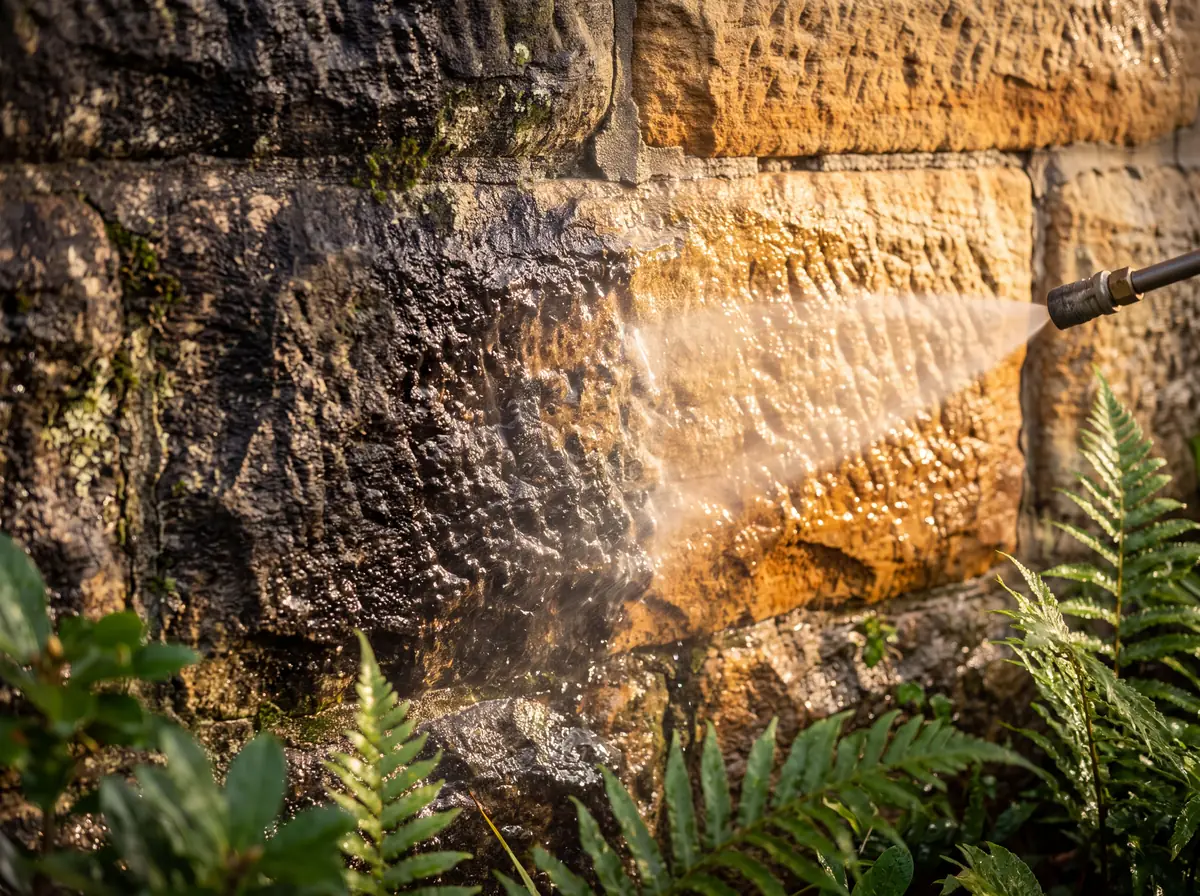
Pittwater waterfront homes need gentler cleaning than almost anywhere else in Sydney. The Hawkesbury sandstone on the western slopes is soft and often hand-cut, the timber decks and jetties sit in permanent shade and humidity, and everything you wash drains straight into an estuary with protected seagrass. The right approach is a biocide or oxygenated cleaner left to dwell, soft brushing, and rinsing at low pressure, timed around the tide on anything near the water, never acid, never a turbo nozzle and never hypochlorite over the water.
I lead our stone work on the Pittwater side, from Bayview and Church Point through Clareville and Careel Bay to the Palm Beach waterfronts. This guide covers the four surfaces that define these properties, sandstone terraces and seawalls, timber decks and jetties, pool surrounds under canopy, and deep-shade render, and what goes wrong when they are cleaned like a suburban driveway.
Why are Pittwater properties different?
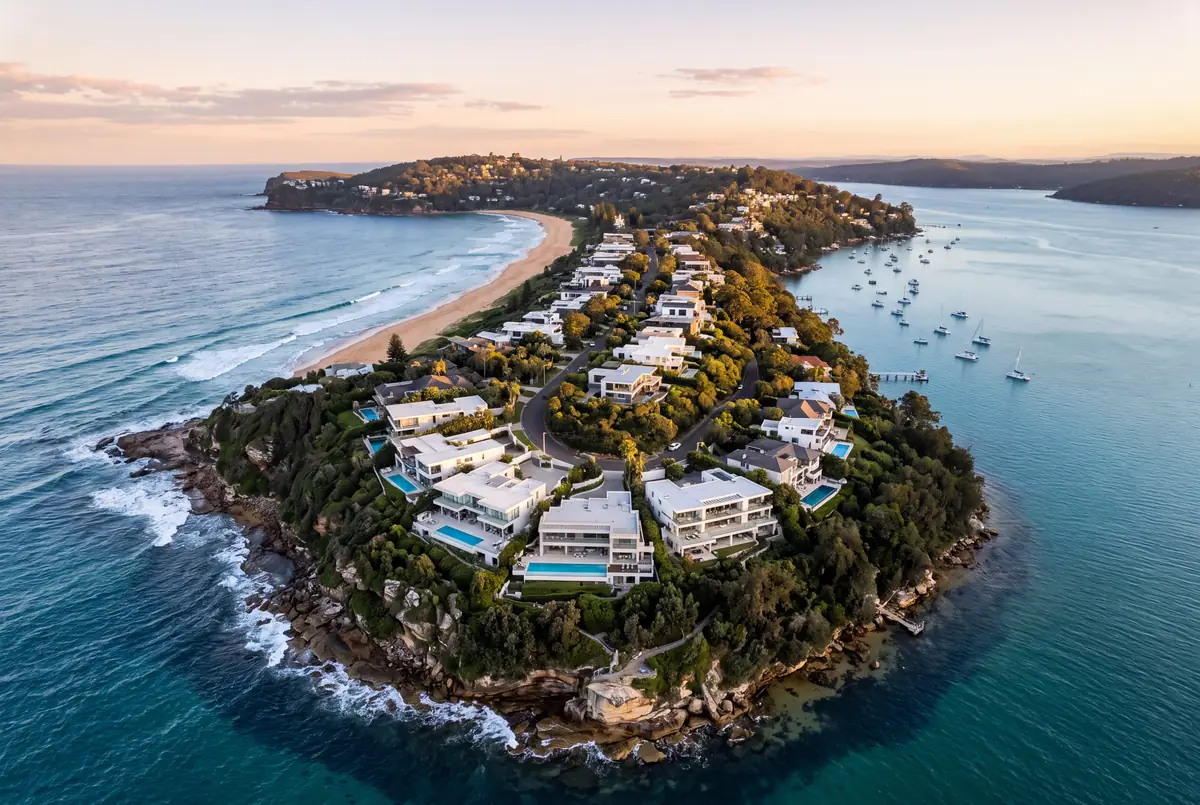
The western, Pittwater-facing side of the peninsula is sheltered from the surf, so salt is a minor problem. What replaces it is shade, humidity, leaf litter and water. Homes sit on steep slopes under spotted gum and angophora canopy, many built as weekenders in the 1950s and since rebuilt as substantial architect-designed houses, with terraces, stairs and walls cut from the sandstone they stand on.
| Suburb | Around | What we see most |
|---|---|---|
| Bayview | Bayview Golf Club and Rowland Reserve and the Pittwater foreshore | tannin and leaf-litter staining on sandstone and concrete, moss and lichen on long stone stairs and tennis courts, green film on timber decks and jetties, and mould under deep eaves |
| Church Point | Church Point ferry wharf and the Pasadena and McCarrs Creek Road | deep-shade mould on render and timber, lichen and moss on sandstone, tannin staining on decks and concrete, and gutters full of leaf on every home |
| Newport | Newport Beach and the surf club and Bungan Head and Bungan Castle | salt and rust on the ocean-side homes, deep-shade mould and tannin on the Pittwater-side decks and stone, and black growth on the south walls of the Barrenjoey Road blocks |
| Avalon Beach | Avalon Beach and the rock pool and Avalon village on Old Barrenjoey Road | salt and black growth on the headland homes' render and glass, moss and lichen on sandstone and timber in the shaded Careel Bay pockets, and mould on the village strata |
| Clareville | Clareville Beach and the reserve and Taylors Point | lichen and moss on sandstone terraces and outcrops, tannin staining on paths and pool surrounds, green film on timber decks, and mould under the deep eaves of the shaded homes |
| Palm Beach | Barrenjoey Lighthouse and headland and Palm Beach rock pool and the Pacific Club | salt on every ocean elevation, humidity and tannin on the Pittwater side, timber that needs the gentlest treatment, and homes left empty between visits so growth gets ahead |
Three things set the method:
- The stone is soft. Hawkesbury sandstone is a quartz sandstone bound weakly with clay and iron. High pressure cuts into it, leaves wand marks and strips the hard outer skin that protects it.
- The growth is biological. Black lichen, green algae and moss, plus brown tannin from leaves, not salt or grime.
- The receiving water is protected. Pittwater's seagrass beds, including protected Posidonia, sit directly below many of these properties.
Understanding Hawkesbury sandstone
The stone under and around Pittwater homes is Hawkesbury sandstone, the same Triassic sandstone that forms Sydney's harbour headlands. It is mostly quartz grains held together by clay and iron oxides, which is what gives it the warm yellow, orange and purple banding owners love. That binding is weak compared with the quartz itself, so the stone wears from the surface inward.
Freshly cut sandstone develops a harder outer skin over years as minerals migrate to the surface and harden. That skin is what keeps the stone from powdering, and it is what a high-pressure wand removes in seconds. Once it is gone the stone beneath is soft, absorbs more water, grows lichen faster and erodes visibly within a few seasons. Every step of our method is designed to clean the growth off the skin without cutting through it, which is why we talk about dwell time and brushing rather than pressure.
The iron in the stone is also why orange staining appears after cleaning with the wrong product: some cleaners mobilise the iron and draw it to the surface. A reducing poultice reverses that without acid.
Sandstone terraces, stairs and seawalls
Most Pittwater sandstone is black with lichen rather than dirty. Lichen is a living crust that holds moisture in the stone surface. The fix is chemical, not mechanical.
- Test patch on an inconspicuous area to confirm the stone's absorbency and how it responds to the biocide.
- Biocide applied at low pressure, a quaternary ammonium product on most stone, left to dwell for 20 to 30 minutes and kept wet.
- Soft brushing with stiff nylon brushes to lift the dead growth.
- Rinse under 500 psi with a wide fan nozzle held well back, never closer than 300 mm.
- Poultice for iron and tannin. Orange ironstone bleeding and brown leaf stains are drawn out with a reducing poultice left for up to 24 hours.
- Breathable sealer, optional, applied only once the stone is dry, to slow tannin staining. Never a film-forming sealer on sandstone; it traps moisture and the surface spalls.
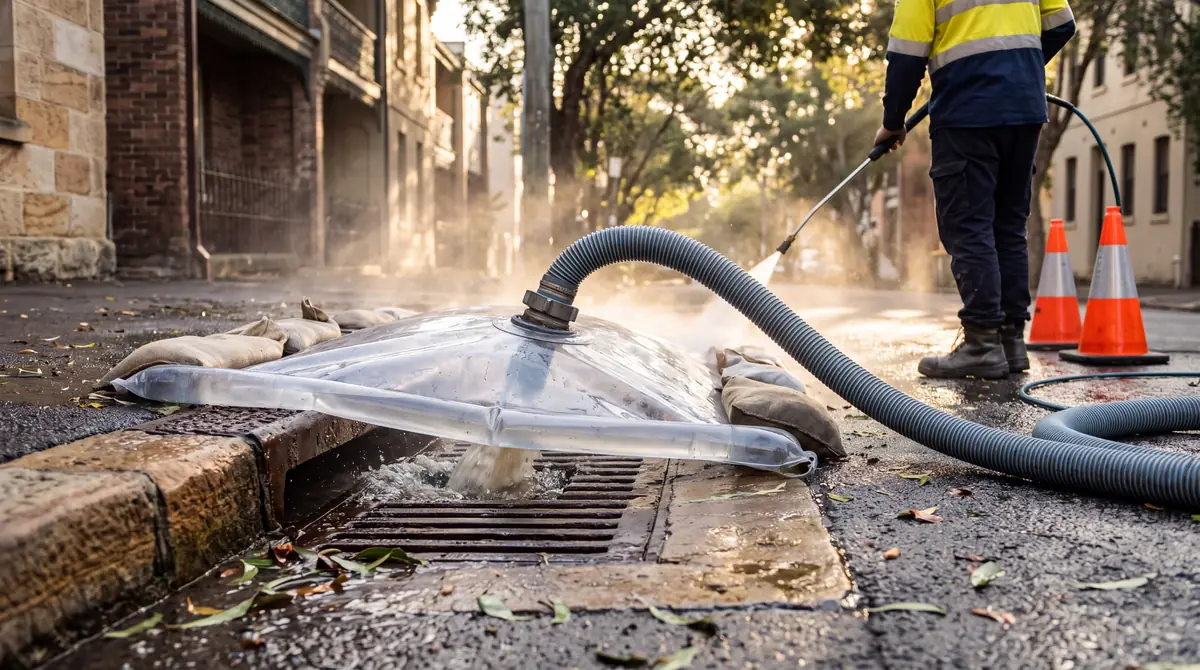
Seawalls and waterline steps are cleaned between tides. We time the biocide dwell so the rinse is finished before the water returns, and booms at the base catch anything that runs off. Natural rock outcrops in the garden are left alone unless you ask; the lichen on them is part of the setting and the rock underneath is often softer than the cut stone.
Need this done properly? Request a quote or call 0494 810 609. We cover every suburb from Manly to Palm Beach and west to Duffys Forest.
Timber decks, jetties and boat sheds
Hardwood decks under the canopy go green within a season, and jetties go slippery. The most common damage we repair on the Pittwater side is a deck that was pressure washed: the fibres lift, the surface furs, and it greys and splits faster afterwards.
- We use an oxygenated, non-chlorine timber cleaner, brushed in and rinsed at very low pressure.
- Over the water, nothing containing hypochlorite is used, and absorbent booms run along the deck edge.
- A timber brightener restores the colour after cleaning; oiling follows once the timber is dry, usually 48 hours later.
- Composite decking is washed with a mild cleaner and a soft brush; it does not need brightening or oil.
Pool surrounds under canopy
Travertine, limestone and sandstone pool surrounds in Clareville, Bayview and Palm Beach collect leaf tannin that soaks into the pale stone as brown shadows of every leaf. Acid cleaners make it worse by etching the surface. We use an alkaline clean, poultice the darker stains, shield the pool and rinse away from the water, then leave a note of what was used for your pool technician. A breathable penetrating sealer afterwards makes next season's tannin far easier to remove.
Deep-shade render and eaves
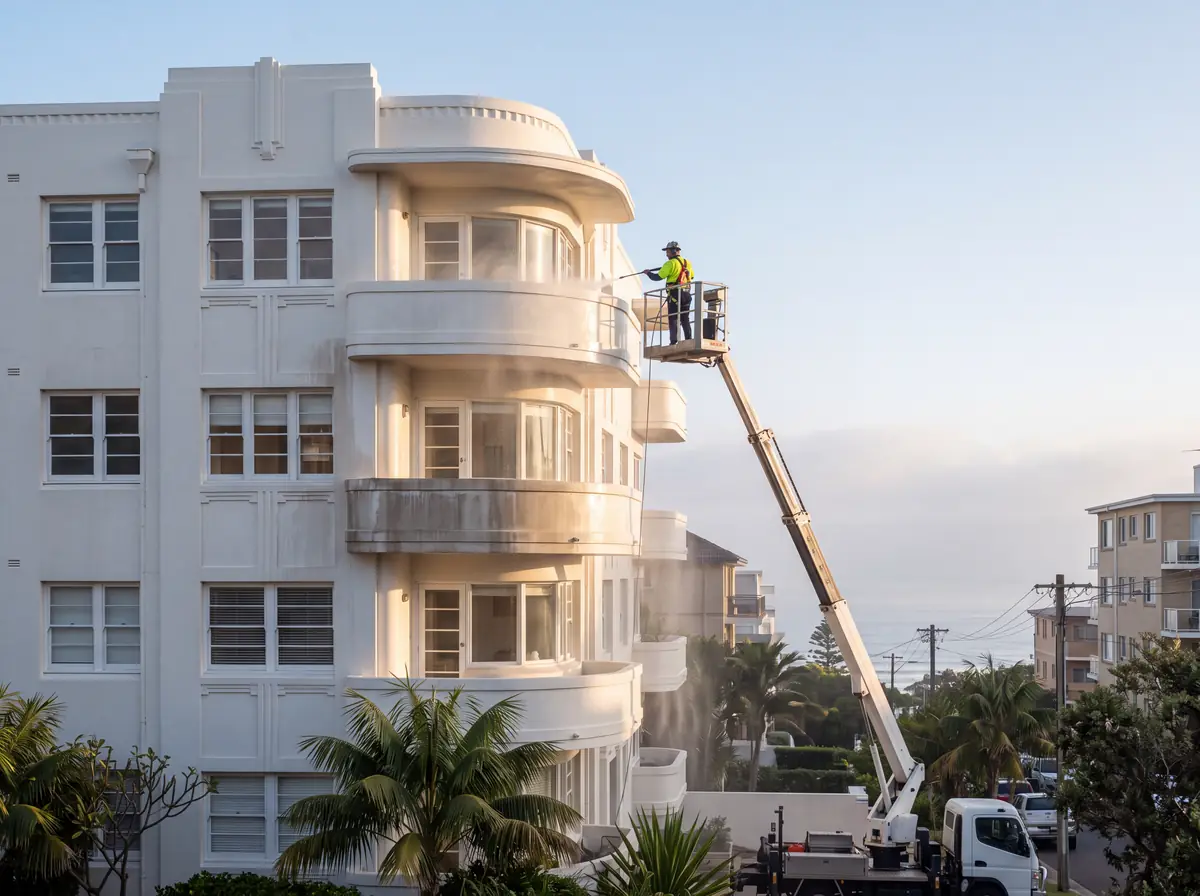
Pittwater homes often have deep eaves and walls that see a few hours of sun in winter. Mould grows on all four elevations, not just the south. A soft wash at low pressure, applied from the bottom up and rinsed from the top down, removes it without forcing water behind cladding. Trimming planting back to a metre from the walls does more to extend the interval than anything we can put on the render.
Access, weekenders and offshore homes
Many Pittwater homes are weekenders. We work without owners present: access and water arranged in advance, a message at start and finish, photos the same afternoon. Steep sites are worked from terraces and harness anchor points rather than ladders on the slope. For Scotland Island and the western foreshores, equipment goes across by barge or the commuter wharves, and the logistics are priced as a fixed figure.
Mistakes we are called to repair on the Pittwater side
- Wand marks in sandstone. Stripes and gouges from a turbo nozzle. The stone cannot be put back, but a careful clean and a breathable sealer make the marks far less visible.
- Acid-etched travertine and limestone. A dull, rough patch where an acid cleaner was used to remove tannin. Honing by a stone restorer is the only full fix.
- Furred and split decking. High pressure on hardwood lifts the fibres. Light sanding, a brightener and oil can recover most decks.
- Spalling under film sealers. Glossy acrylic sealers on sandstone trap moisture and the surface flakes off in sheets. The failed sealer has to be stripped before anything else will work.
- White bloom on render. Usually a strong hypochlorite mix left to dry in the sun. It fades with gentle rinsing over a few weeks.
How a typical terrace and jetty job runs
On a Clareville or Bayview waterfront with sandstone terraces, a long flight of stone stairs, a pool and a timber jetty, we usually plan two days.
- Day one, morning: test patches on each stone, then biocide on the upper terraces and stairs, worked downhill so the rinse never crosses cleaned stone.
- Day one, afternoon: pool surround cleaned with the pool shielded, tannin poultices laid on the worst stains and covered overnight.
- Day two, around low tide: seawall and waterline steps cleaned with booms in place, then the jetty with an oxygenated cleaner.
- Day two, afternoon: poultices lifted, final rinse, timber brightener on the jetty, and the photo report sent. Oiling and any sealing follow once everything is dry.
Seasonal timing on Pittwater
Late spring is the best time for stone and timber on the Pittwater side: growth from the wet winter is at its worst, the weather is dry enough for sealers and oil to cure, and the work is finished before summer guests arrive. Pool surrounds are often done again in late autumn after the heaviest leaf fall. Weekenders usually book both visits together.
Choosing a contractor for a Pittwater property
Ask for a test patch on your own stone before you commit, ask what pressure will be used on sandstone and what will be used over the water, and ask to see the method in writing. Anyone who arrives with only a high-pressure wand is the wrong fit for these properties, however good the price. It is also worth asking whether they carry booms and oxygenated cleaners for work near the water, and whether the same person who quotes will be on site, because judgement on soft stone is not something that can be handed to a new starter.
What to do next
Walk the stairs to the water and note where the stone is black, green or brown, and whether the deck boards feel furred. Then book sandstone cleaning or deck cleaning on the Northern Beaches with a test patch on the quote visit. Suburb detail for Bayview, Church Point, Newport, Avalon Beach, Clareville is on each suburb page.
Related: Sandstone Cleaning Northern Beaches, Deck & Patio Cleaning Northern Beaches, Stone Sealing Northern Beaches, Northern Beaches service area.